Migrate VMware to CloudStack with Sendense and Control the Cutover.
Move the estate—not just the virtual disks.
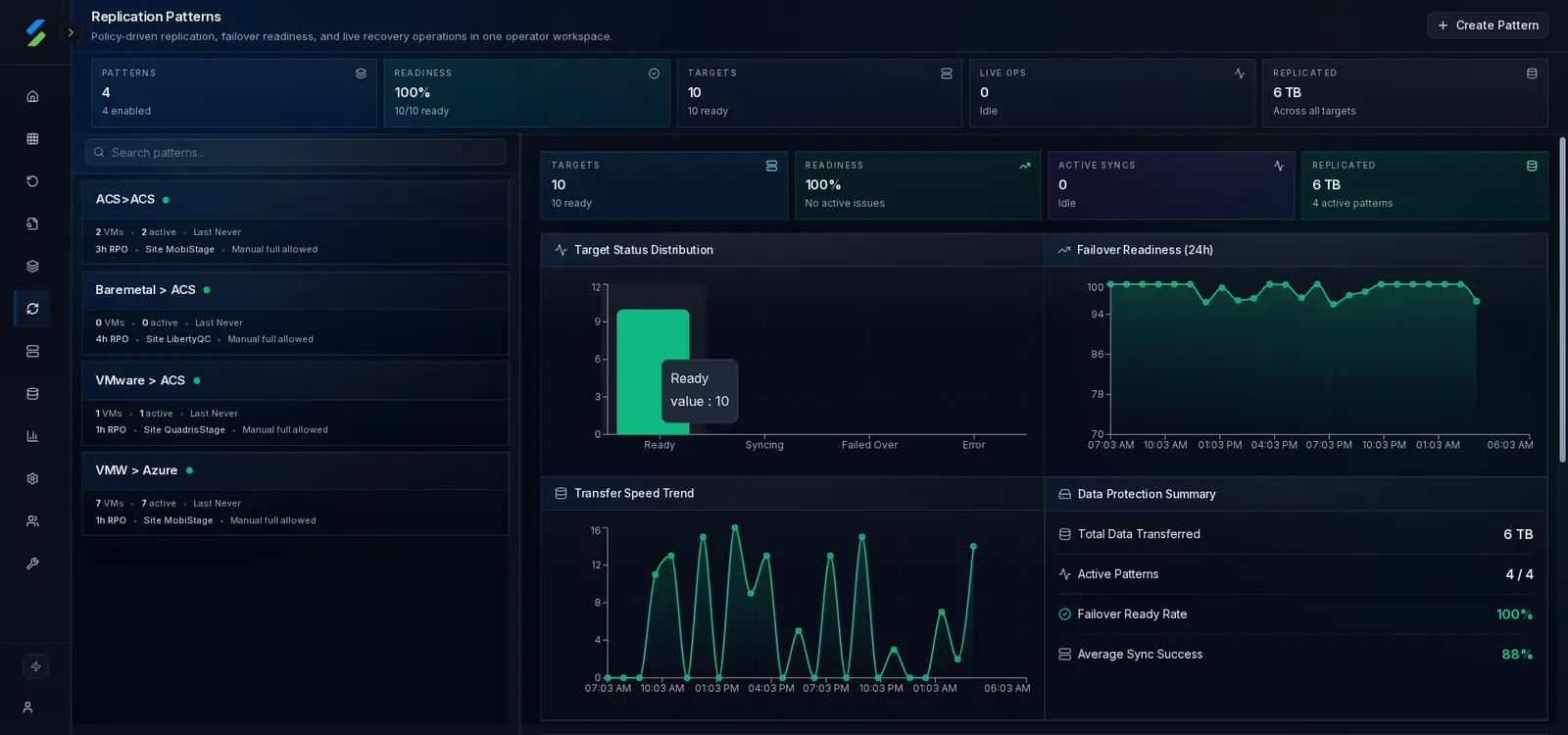
Sendense uses its own end-to-end data path to replicate VMware workloads into KVM-backed Apache CloudStack across local or remote sites. It keeps workloads synchronized while production runs, prepares each guest, controls cutover and supports protection on the target.
Under 1 hour
Deployment to Replication
14 days
Complete VMware estate migrated
Ongoing BaaS
Same platform after cutover
Measured in one Quadris customer project. Results vary by estate, connectivity, dependencies and cutover requirements.
Built for Complete Estate Migration
One Platform from Remote VMware Sites to Protected CloudStack.
Sendense uses its own end-to-end migration workflow to move VMware estates into CloudStack. It connects local or remote sites, keeps workloads synchronized while production runs, prepares them for KVM and coordinates controlled cutover batches through to post-migration protection.
Migration capability
Remote-site migration
What Sendense delivers
Move VMware workloads to CloudStack over a LAN or WAN. Across a WAN, Sendense requires only TCP port 443.
Operational benefit
Migrate customer, branch and datacentre estates without requiring the source and target to be colocated.
Migration capability
Ongoing synchronization
What Sendense delivers
Run an initial copy followed by scheduled or operator-triggered incremental synchronization while production remains online.
Operational benefit
Keep the destination current and reserve the production window for the final delta and activation.
Migration capability
Complete estate orchestration
What Sendense delivers
Group multiple VMs into replication patterns with workload order, exclusions and controlled concurrency for cutover batches.
Operational benefit
Coordinate application estates as one migration programme instead of disconnected VM moves.
Migration capability
Cross-platform preparation
What Sendense delivers
Prepare guest storage and network drivers, boot configuration, recovery networking and target metadata for KVM-backed CloudStack.
Operational benefit
Reduce manual guest rework and arrive ready for boot and application acceptance testing.
Migration capability
Established CloudStack estates
What Sendense delivers
Use version-aware compatibility paths across supported established and current CloudStack releases.
Operational benefit
Support customers whose CloudStack estate is not yet on the newest release; exact compatibility is confirmed in the pilot.
Migration capability
Controlled cutover
What Sendense delivers
Check target readiness, test recovery, then run final synchronization and planned failover with explicit commit or rollback.
Operational benefit
Prove the recovery path and retain a return point until the production change is committed.
Migration capability
Protection after migration
What Sendense delivers
Enroll promoted CloudStack workloads into Sendense backup, retention, validation and recovery policies after cutover.
Operational benefit
Keep migration and day-two recovery in one operating platform.
Remote-site performance and available target paths depend on connectivity, CloudStack release, storage and KVM capabilities. Sendense confirms these requirements during the migration pilot.
Move a complete VMware estate—not just its disks. Replicate across sites, control cutover by workload group and protect the promoted workloads on CloudStack after migration.
Sendense Migration Workflow
One Operating Path from First Sync to Protected Target.
Prepare and prove each workload before the production window; use the final synchronization and activation runbook only when the acceptance criteria are met.
Assess
Inventory VMware VMs, guest operating systems, boot modes, application dependencies, data size and the required cutover sequence.
Map
Match each workload to CloudStack compute, storage and network constructs, including IP and MAC identity decisions.
Protect and sync
Protect the source and replicate toward the destination so the final window is not consumed by a full data copy.
Convert and verify
Prepare the guest for KVM-backed CloudStack, then test boot behavior, networking and application acceptance.
Cut over
Run the agreed final synchronization, start the target and make the production change only after the exit checks pass.
Continue protection
Enroll the CloudStack workload into backup, retention, validation and recovery workflows after migration.
Before
Prepare
Inventory, destination mapping and acceptance criteria happen before the final window.
During
Control
Final synchronization and target activation follow an agreed production runbook.
After
Protect
Enroll the CloudStack workload into ongoing backup, retention, validation and recovery.
Destination Readiness
Make CloudStack Ready Before the Workload Arrives.
A migration plan is ready when the guest, KVM-backed CloudStack destination and production change are all testable—not when the disk copy has merely started.
Guest readiness
Confirm supported operating systems, boot mode, disk layout, KVM virtio readiness and the plan for VMware guest tooling.
- Windows and Linux conversion
- Boot-critical storage drivers
- Network interface configuration
CloudStack readiness
Prepare a KVM-backed destination with the service offerings, templates, storage capacity and network mappings the workloads require.
- Compute and storage placement
- Network and security rules
- Target naming and ownership
Cutover readiness
Define dependency order, acceptance tests, the final sync window and the conditions for commit or rollback.
- Application owner sign-off
- DNS and IP change plan
- Documented return point
Customer Proof — Quadris
A Complete VMware Estate Moved Inside the Customer Deadline.
Quadris deployed Sendense and began replication into its Apache CloudStack-based Quadris Cloud in under an hour. The complete customer estate migrated in 14 days, followed by ongoing Backup as a Service through the same platform.
Under 1 hour
Deployment to replication
14 days
Complete vmware estate migrated
Ongoing BaaS
Same platform after cutover
Results from one customer project. Migration timelines vary according to estate size, connectivity, workload dependencies and cutover requirements.
Read the Quadris customer story
Migration FAQs
VMware to CloudStack, Answered.
Clear answers about the Sendense workflow, KVM scope, cutover time, backup continuity and the Quadris result.
01Can Sendense migrate complete VMware estates to Apache CloudStack?
Yes. Sendense combines remote-site connectivity, incremental replication, cross-platform guest preparation, multi-VM orchestration, readiness checks, controlled cutover and post-migration protection for KVM-backed Apache CloudStack.
02Can Sendense migrate VMware to CloudStack over a LAN or WAN?
Yes. VMware sources and CloudStack destinations can be on the same LAN or across a WAN, including separate datacentres and customer sites. WAN migration requires only TCP port 443. Incremental synchronization keeps the destination current before the final cutover window.
03Which CloudStack versions and hypervisors can Sendense target?
This VMware migration path targets KVM-backed CloudStack and supports established estates across supported older and current releases through version-aware compatibility paths. The migration assessment confirms the exact release, storage and network design before the pilot.
04How much downtime does a VMware-to-CloudStack migration require?
There is no universal downtime figure. Replication can reduce the data left for the final window, but the result depends on estate size, change rate, connectivity, guest conversion, application dependencies and acceptance testing.
05What happens to backup after the migration?
Sendense can protect the source before cutover and enroll the promoted CloudStack workload into ongoing backup, retention, validation and recovery policies after commit. Migration and day-two recovery remain in one operating platform.
06Has Sendense been used for a complete VMware-to-CloudStack migration?
Yes. Sendense has been used for complete VMware-to-CloudStack migrations. The Quadris case study is one published example: a complete customer VMware estate was migrated into Quadris Cloud inside the customer’s deadline and Sendense remains in place for ongoing Backup as a Service. Results vary by estate, connectivity, dependencies and cutover requirements.

Plan a VMware-to-CloudStack Pilot with Sendense.
Review the VMware source, KVM-backed CloudStack target, guest conversion requirements, acceptance checks and protection model with Sendense.