CloudStack Integration Built For Provider Operations.
Connect once. Preserve CloudStack context across backup, replication and recovery.
Scoped API access gives Sendense the zone, tenant, host, workload and storage context needed to select the qualified protection path and govern recovery operations through one provider-ready platform.
API
Scoped Access
Zone
Estate Discovery
Path
Data-Path Selection
Ops
Recovery Workflows
Moving an existing estate? See how Sendense supports a controlled VMware to CloudStack migration.
See CloudStack Context Carried Through Protection.
See how Sendense moves from CloudStack inventory and source-path selection to governed recovery points without losing the operational context of the estate.
CloudStack Backup Across Supported Storage Backends
Qualified paths · Full-source reads · EBA efficiency · guest-independent protection
What it covers
Integration Surfaces
CloudStack Context Stays Attached To Every Operation.
Scoped API access, estate discovery, explicit data-path selection and recovery orchestration form one integration. Exact backend support remains in the CloudStack storage backends page.
CloudStack API
Scoped Control-Plane Access
Sendense uses scoped CloudStack credentials for inventory and the protected VM, volume, snapshot, restore and recovery operations required by the workflow.
Estate Discovery
CloudStack Context Preserved
Zones, tenants, hosts, workloads and storage context are mapped so policy and recovery actions remain attached to the CloudStack estate operators recognise.
Protection Path
Explicit Per Workload
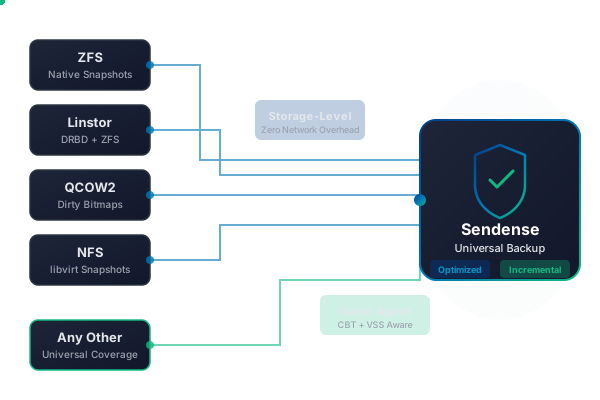
Sendense selects the qualified native, host-assisted or full-source-read path for the workload instead of assuming every backend exposes the same capability.
Recovery Operations
Governed Workflow
Recovery points, restore operations, replication checkpoints and validation evidence stay in one Sendense operational model.
Operational Controls
Inventory, Protection And Recovery Share One State.
Sendense preserves CloudStack context while operators move from policy to recovery point, replication checkpoint, restore and validation.
Inventory Keeps CloudStack Context
Policies and operations retain the zone, tenant, host, workload and storage context discovered through the CloudStack integration.

Protection Paths Are Explicit
The qualified data path and its prerequisites are selected for the workload, while EBA governs retained recovery-point efficiency.

Recovery Operations Stay Governed
Restore, validation, replication checkpoints and CloudStack recovery workflows remain attached to Sendense operational state and evidence.
CloudStack Data Path
From Zone Inventory To Governed Recovery Point.
Sendense discovers the CloudStack estate, selects the qualified protection path, coordinates volume state and retains governed recovery points in EBA. The compatibility matrix records the path and prerequisites for each backend.
Discover
CloudStack zones, tenants, hosts and storage are mapped through scoped credentials.
Select Path
Sendense uses qualified native or host-assisted changed-block paths where available; otherwise it selects a safe CloudStack-aware full-source-read path.
Snapshot
VM disks are captured through CloudStack-aware volume operations, using the required snagent host path for qualified QCOW NFS, ZFS, and LINSTOR DRBD modes.
Track Blocks
Qualified native or snagent host-assisted paths use changed-block information. Other supported paths scan and read the full source, with EBA reducing retained data.
Store
Protected blocks land in the Sendense repository path with EBA retention and efficiency controls.
Recover
Operators restore, validate or migrate CloudStack workloads from governed recovery points.
Storage-Level When Possible
Host-Assisted CBT Reduces Backup Noise.
For Linstor/DRBD, ZFS, and QCOW2/NFS, Sendense uses qualified host-assisted CBT through snagent. For Ceph RBD, raw block, XCP-ng storage repositories and other supported paths, CloudStack-aware full-source reads and EBA Smart Transport keep the same operating model available.
Full-Source Reads Where Needed
Coverage Stays Complete For Mixed Estates.
Other supported CloudStack storage types scan and read the full source when no qualified native or host-assisted changed-block path is selected. EBA deduplication keeps retained data efficient without claiming source-side incremental reads.
Your Cloud. Your Backup Platform.
Run Sendense as a managed backup platform for CloudStack tenants. Keep the repository, reporting and service packaging under your control.
Sendense Cloud Appliance
Tenant Backup Becomes A Product Surface.
SCA centralizes customer view, usage signals, EBA hosting options and operational reporting without forcing every tenant into the same storage backend.
Tenant-Aware Operations
Manage customer backup policies, quotas and reporting while preserving CloudStack tenant isolation.
Billing-Ready Usage
Expose per-VM and per-GB service signals that map cleanly to backup-as-a-service and DRaaS packaging.
Provider-Owned EBA
Host the repository foundation on your storage and preserve the margin around backup and archive services.
One Skill Set
Operate mixed CloudStack storage with one protection model instead of a different tool per backend.
Why This Matters
CloudStack Operations Need More Than An API Connection.
Discovery, path qualification, recovery state and evidence have to remain connected after the initial integration succeeds.
Operations Start With Cloud Context
Protection policy needs the tenant, zone, host, workload and storage context that CloudStack operators use every day.
Data Paths Must Be Explicit
Sendense records the qualified path and prerequisites for each workload rather than treating every backend as operationally identical.
Recovery Needs State And Evidence
Governed recovery points, replication checkpoints, validation and job evidence matter after the initial protection policy is created.
CloudStack Integration FAQs
How The CloudStack Integration Operates.
Answers about scoped API access, discovery, data-path selection, restore resources and replication checkpoints.
01How does Sendense integrate with Apache CloudStack?
Sendense uses a dedicated CloudStack API user with the required role permissions to discover the estate and coordinate the VM, volume, snapshot, restore and recovery operations used by protection workflows.
02What CloudStack context does Sendense discover?
Sendense maps the zones, tenants, hosts, workloads and storage context needed to place policy, protection and recovery operations against the correct CloudStack resources.
03How does Sendense select a protection path?
The integration evaluates the workload and storage context, then uses the qualified native or host-assisted changed-block path where available or a CloudStack-aware full-source-read path for other supported combinations.
04What CloudStack resources are needed for restore and replication?
Commissioning includes the Sendense Controller Template, DHCP network and the CloudStack offerings required by the planned restore and replication workflows.
05Why does Sendense create CloudStack Volume Snapshots during replication?
They are short-lived destination rollback checkpoints, not retained backups. Sendense creates one for each replica data volume before a synchronization updates the controller-backed replica, deletes them after success, and can use them with saved replication baselines to restore the previous consistent replica state after a failed write.
06How are service-provider tenants handled?
Sendense keeps customer, tenant, policy, usage and operational reporting context available while CloudStack role permissions preserve the scoped control-plane boundary used for the deployment.
07Where is storage and hypervisor compatibility documented?
The CloudStack storage and hypervisor compatibility matrix names the supported combinations, selected Sendense data path and deployment requirements for planning.
08How does the CloudStack integration connect to EBA?
Protected blocks land in the Sendense repository path, where EBA provides deduplication, compression, encrypted storage, retention controls and efficient restore behaviour.
Map Sendense Onto The CloudStack Estate You Operate.
Review the required API scope, estate context, protection paths, controller resources and recovery workflows with Sendense.