
EBA Repository Services At Infrastructure Scale.
Immutable, high-efficiency backup storage with controller-managed hot block writeback on suitable SSD media.
Enterprise Block Archive is the Sendense repository engine for long-term VM protection. It reduces storage consumption through software-defined deduplication, compression and encryption, while keeping recovery points fast to browse, validate and restore.
9:1
Dedupe Potentials
90%
Less Backup Trafic
SSD
Hot Writeback Tier
0
Dedupe Appliances
Dedupe · Compression · Sparse/zero elimination · Controller-managed SSD writeback · Immutable retention · No dedicated appliance hardware
How EBA Works.
Start with the repository model behind Enterprise Block Archive, then continue into the product walkthrough below for the operator view.
How EBA Works
Repository efficiency · retention controls · validation and restore path
What it clarifies
Watch EBA In Action.
A guided look at Enterprise Block Archive in the Sendense platform, with captions enabled by default.
EBA Product Walkthrough
Enterprise Block Archive · repository workflow · captions enabled
Repository Showcase
EBA Turns Storage Into A Recovery Engine.
Smart Transport, deduplication, SSD writeback, direct restore, immutability and external archive reduction are part of the repository path, not separate appliances or after-the-fact scripts.

EBA Smart Transport
On claims-enabled transport modes, repository-held blocks can be skipped before upload. RAW Block Sendense CBT uses full-source ingest, while EBA repository deduplication avoids retaining duplicate content.
Learn More
EBA data reduction
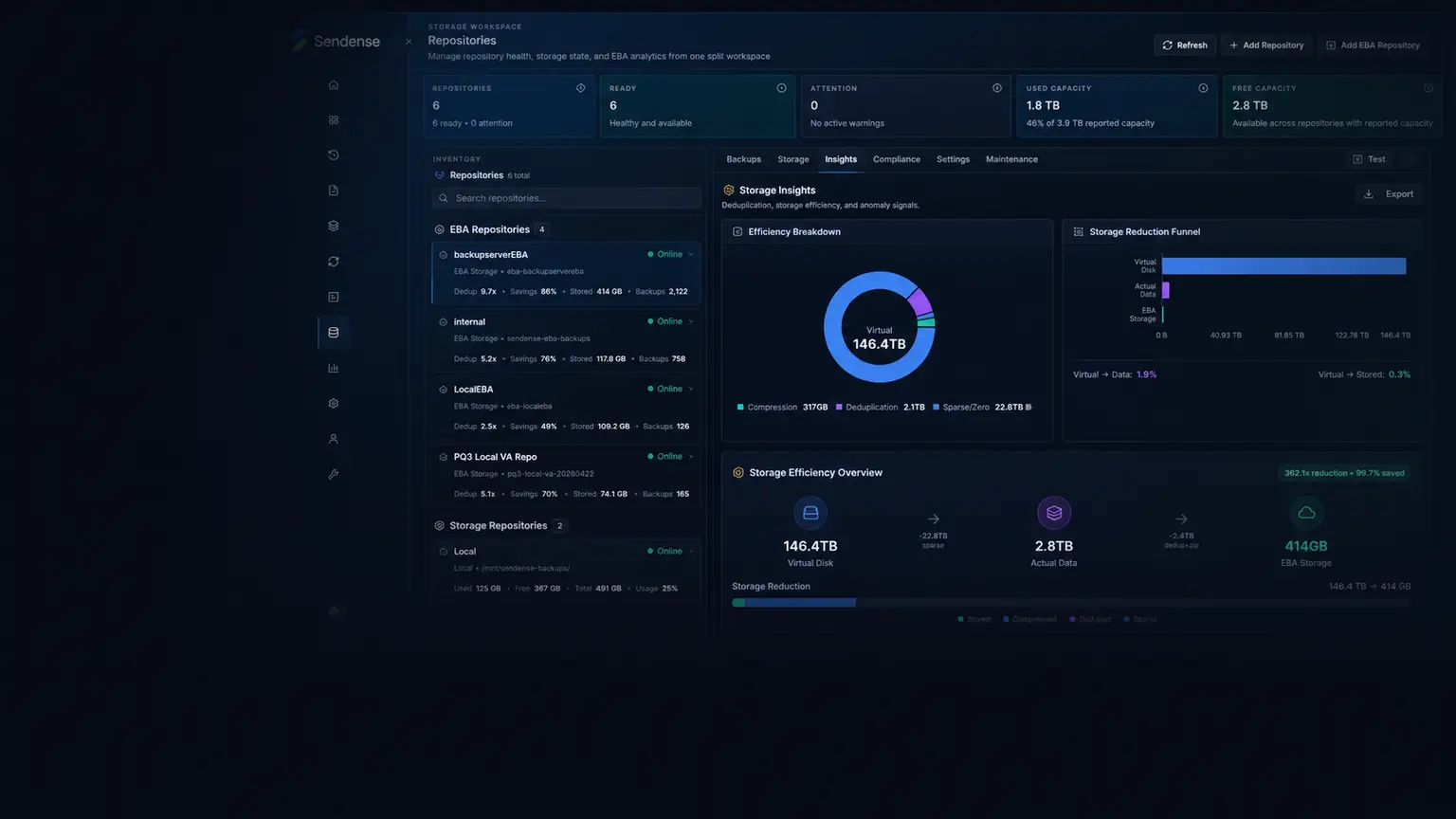
EBA fingerprints, deduplicates and compresses VM data so shared blocks are stored once across long retention chains. Actual reduction depends on workload mix, change rate and retention.
Learn More
Compare repository designs
Compare Sendense EBA with raw spinning repositories and dedupe-appliance designs using labelled assumptions. Results depend on environment and commercial terms.
Learn More
Hot Block Writeback Tier
When a GUI-built EBA repository has suitable SSD media, the controller automatically provisions a fast writeback tier for hot blocks.
Learn More
Fast Restores, No Rehydration
Sendense can browse, validate and restore directly from the recovery point, reading only the data needed instead of rebuilding the full archive first.
Learn More
Immutable By Design
Retention, legal hold and controlled deletion live inside the repository layer, giving protected backups a policy and audit trail.
Learn More
Lower External S3 Footprint
EBA reduces duplicate archive writes before data leaves Sendense, helping shrink offsite object storage and transfer overhead.
Learn More
Reduce Duplicate Transfer on Claims-Enabled Paths.
Smart Transport is built into Sendense EBA as standard. Duplicate VM blocks are identified before transfer, so data already protected by EBA does not have to cross the wire or consume repository capacity again.
This is not throttling, not a bolt-on WAN optimizer and not target-only dedupe after the network has already paid the price. EBA makes the transfer decision inside the repository path.
90%
Less backup traffic where data is dedupeable
94%
Real 160 GiB VM run reduction
0
WAN accelerator appliances
Claims-Enabled EBA Smart Transport Run
160 GiB VM · duplicate data already present in EBA
Baseline Full
127 GiB
Network transfer
Smart Run
8.2 GiB
Network transfer
Avoided
119 GiB
Not sent again
Expected savings depend on workload similarity, change rate, prior EBA protection history and how much data is dedupeable. The 94% figure is from a real Sendense EBA run, not a lab-only ratio.
Cloud Egress Relief
Avoid transferring duplicate backup data into or across cloud regions when EBA already has the blocks.
Tenant-Scale Backup
Service providers can protect more customer workloads without turning backup windows into shared network pressure.
Bottleneck Protection
Routers, firewalls and inter-site links stop absorbing full backup storms for data that is already protected.
CBT Reset Protection
On claims-enabled transport modes, a forced full read can still skip repository-held blocks before upload.
When The Hypervisor Forces A Full, The Network Should Not Have To Pay.
HA events, storage changes, snapshot problems and invalid change maps can force a full backup. Smart Transport keeps that bad day from becoming a network and storage emergency.
Without Smart Transport
A Forced Full Becomes A Network Event
A 4 TB VM hits a CBT reset after HA or storage disruption. The platform treats the next run as a full, pushing terabytes through production links and backup networks.
With Smart Transport
The Wire Behaves Like An Incremental
On claims-enabled transport modes, repository-held blocks can be matched before upload so only new data crosses that path. RAW Block Sendense CBT sends the full source through ingest; repository deduplication still avoids duplicate retained content.
Hot Block Writeback Without Extra Storage Design.
When a self-hosted EBA repository is built from the GUI, the controller can provision a hot block writeback tier automatically if suitable SSD drives are present. If they are not, the repository still commissions cleanly without the acceleration tier.
Detect
Target Media Profile
Assign
Eligible SSD Tier
Protect
Deduped EBA Store
New EBA Repository
GUI Commissioning Sequence
Detect
01Suitable SSD Media
The controller inspects the target profile during GUI commissioning.
Provision
02Hot Writeback Tier
Eligible SSD drives are assigned to the EBA hot block path automatically.
Fold Back
03Protected EBA Store
Data is folded into deduplicated, encrypted, governed repository storage.
Hot Block Writeback Path
Repository build continues cleanly if no suitable SSD tier exists.
Repository Data Path
From VM Blocks To Governed Recovery Points.
EBA reduces, accelerates, protects and restores from the same repository flow. The result is efficient retention without waiting for full archive rehydration before useful recovery work can begin.
Capture
Recovery point metadata and changed blocks enter the repository path.
Fingerprint
Blocks are chunked and identified before storage decisions are made.
Reduce
Where claims-driven source-side deduplication is active, duplicate data can be skipped before upload; repository deduplication reduces duplicate retained content.
Accelerate
Hot blocks can pass through the controller-managed SSD writeback tier.
Govern
Encryption, retention, legal hold and deletion controls stay attached.
Recover
Sendense reads only what restore, browse or validation workflows need.
Restore Reads What the Workflow Needs.
File browse, validation and full restore can work directly from the recovery point. EBA does not force a large archive image to be rebuilt before recovery workflows become useful.
Direct Restore Lane
Only the required block stream leaves the repository path.
Governed Retention
Backups Are Protected, Reduced And Governed In One Repository Layer.
EBA keeps retention policy, legal hold, controlled deletion, encryption and external archive efficiency tied to the recovery point rather than scattered across repository projects.
Repository Control Plane
Policy, Reduction And Archive Behavior Move With The Recovery Point.
Instead of splitting governance, dedupe and object storage into separate projects, EBA keeps the repository decisions visible in one protected path.
Policy Stays Attached
Retention And Legal Hold
Immutable retention, legal hold, release controls and audit history are managed in the repository layer.
Reduction Before Archive
Lower Archive Footprint
EBA deduplicates before external S3-compatible storage, reducing duplicate object writes and transfer overhead.
Built Into Sendense
No Appliance Island
Deduplication, compression, encryption and lifecycle controls ship with Sendense rather than specialist repository hardware.
Storage and cost savings vary by workload similarity, change rate, retention depth, encryption scope and external storage provider pricing.
EBA Repository Commissioning
Target verified · SSD tier eligible · lifecycle controls enabled
Local Control Without Hand-Built Repository Islands.
For self-hosted deployments, Sendense guides repository commissioning from the GUI: target readiness, host identity confirmation, storage layout, health verification and lifecycle management all stay visible from the platform.
EBA FAQs
FAQs for EBA.
Practical answers for buyers and operators evaluating EBA as the Sendense repository foundation.
01What Is Sendense Enterprise Block Archive?
Enterprise Block Archive, or EBA, is the Sendense repository service for long-term VM backup storage. It combines deduplication, compression, encryption, immutable retention and recovery workflows in one repository layer.
02Does EBA Need A Separate Deduplication Appliance?
No. EBA is built into Sendense, so deduplication, compression, encryption, retention and lifecycle controls ship with the platform rather than a dedicated repository appliance.
03What Is EBA Smart Transport?
Where claims-driven source-side deduplication is active, EBA Smart Transport can identify repository-held blocks before upload and avoid retransferring them. RAW Block Sendense CBT uses full-source ingest, while repository deduplication still avoids retaining duplicate content.
04How Does EBA Help When CBT Resets Force A Full Backup?
On claims-enabled transport modes, a forced full read can still skip repository-held blocks before transfer. RAW Block Sendense CBT sends the full source through ingest while repository deduplication avoids retaining duplicate content.
05How Does The SSD Writeback Tier Work?
When a new self-hosted EBA repository is created from the GUI, the controller can automatically provision a hot block writeback tier if suitable SSD media is available. If not, the repository still commissions without that acceleration tier.
06Can EBA Restore Without Full Archive Rehydration?
Yes. File browse, validation and full restore workflows can read directly from the recovery point, so Sendense does not need to rebuild a large archive image before useful recovery work starts.
07How Does EBA Reduce External S3-Compatible Storage Costs?
EBA reduces duplicate and sparse data before archive writes are created, helping lower object storage footprint, duplicate transfer overhead and repeated external archive writes.
Immutable By Design. Efficient By Default.
EBA gives Sendense a repository foundation for deduplication, SSD writeback, fast recovery, external S3 cost control and protected retention.